Reflection on the Quarter 1 Theme:
Quarter 1 Columnist Rhetorical Analysis Reflection : David Brooks is an American conservative political and cultural commentator who writes for New York Times. David Brooks writing on sociology has been criticized for being based on stereotypes and presenting false claims as factual. Two of his most used rhetorical devices are pathos and logos. In one of his articles called "The Uses of Patriotism" , he uses these two devices to support his claim that we are not getting anywhere if we do not show patriotism towards our country. In this article David Brooks tries to convince us how kneeling during the national anthem is extremely counterproductive. In this article he uses logos by saying “There's been a sharp decline in American Patriotism. Today only 52 percent of Americans are “extremely proud” of their country, a historical low. Among those 18 to 29, only 34 percent are extremely proud”. With the athletes kneeling during the national anthem, Brooks believed that is just leading to unpatriotism rather than helping the issue. David Brooks also uses pathos to substantiate his claim by referring to phrases said by historical people such as Martin Luther King and Abraham Lincoln. He used quotes from these historical figures to illuminate his claim that Americans are becoming less patriotic. Brooks also uses ethos when he said “We lose the sense that we’re all in this together. We’all lose the sense of shared loyalty to ideas bigger and more transcendent than our own short lives”. He used words like “we” and “loyalty” to appeal to the audience's emotions that we are all Americans and we should act like it.
Quarter 1 Novel , The Great Gatsby :The American Dream is the belief that anyone, regardless of race, class, gender, or nationality, can be successful in America (read: rich) if they just work hard enough. F. Scott Fitzgerald portrays a negative critique of the American Dream. In the novel Jay Gatsby achieves his dream of wanting to be apart of the upper class and he achieves this by working hard to become a very rich man only to find himself being rejected by the upper class men. Jay Gatsby wanted to be rich so he can win the love of his life back but he still did not win her back. Gatsby was later shot over a misunderstanding that Gatsby had an affair with George Wilson's wife and killed her in the car accident. The book portrays that the American Dream is an idea that anyone can rise to the top with enough hard work. 
Jefferson- Stanton Comparison Rhetorical Analysis Essay : Formal Essay-
Hawa Sylla
Period: 2A/2B
AP Language 11
The Declaration of Independence, is the founding document of the American political tradition written by Thomas Jefferson in July 1776. This legal document was written to secure the freedoms of the citizen’s lives, liberty, and their pursuit of happiness. The purpose of the The Declaration of Independence is to state that the United States is no longer going to be apart of Great Britain and to acknowledge their independence. In addition, Elizabeth Cady Stanton wrote a modified version of The Declaration of Independence called The Declaration of Sentiments and Resolutions which was written in July 1848. This document outline the right that the to American women should be entitled to as citizens. The Declaration of Sentiments and Resolutions was based on The Declaration of Independence to parallel the struggles of the Founding Fathers with those of the women's movement. Both Thomas Jefferson and Elizabeth Stanton use Ethos, Logos, and Pathos to advance their argument regarding their vision of the American Dream.
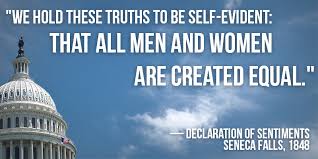
Thomas Jefferson and Elizabeth Stanton both use credibility or ethos to advance their argument about their vision of the American Dream. In The Declaration of Independence Thomas Jefferson Stated, “When in the course of human events it becomes necessary for one people to have connected them with another, and to assume among the powers of the earth, the separate and equal station to which the Laws of Nature and of Nature’s God entitle them a decent, respect to the opinions of mankind requires that they should declare the causes which impel them to the separation.” This quote summarizes what the speech is going to be about but also gives credibility to the “Laws of Nature” and “Nature's God” for the United States separation from Great Britain. In the Declaration of Sentiments and Resolutions, Elizabeth Stanton stated “We hold these truths to be self-evident: that all men and women are created equal; that they are endowed by their Creator with certain unalienable rights; that among these are life, liberty, and the pursuit of happiness; that to secure these rights governments are instituted, deriving their just powers from consent of the governed”. Elizabeth Stanton gives credibility to “Their Creator” to show the audience what she believes in and to illuminate the fact that people are entitled to rights, liberty, and their pursuit of happiness. In the Declaration of Independence Thomas Jefferson also stated that “Prudence, indeed will dictate that Governments long established should not be changed for light and transient causes; and accordingly all experience hath shewn that mankind are more disposed to suffer, while evils are sufferable, than right themselves by abolishing the forms to which they are accustomed”. Thomas Jefferson gives accountability to “Prudence” that Governments should not be altered for insignificant reasons and in accordance with that, knowledge has shown that mankind is likely to suffer more when evil exists than to make things right by destroying what they're familiar with. In the Independence of Sentiments and Resolutions, Elizabeth Stanton states “He has denied… He allows her… He was created… He has usurped...He has endeavored…”. Elizabeth Stanton states the unjust treatment of women and credits “He” which are the general men for these acts. Stanton justifies that it is because of men that women are being treated unfairly. Thomas Jefferson uses an appeal to ethos when he establishes his authority in the last paragraph. He states that he, as well as the others who signed the declaration, are “the Representatives of the united States of America, in General Congress,” which shows the status and credibility of the men enforcing this declaration.
Another rhetorical device that Thomas Jefferson and Elizabeth Stanton provide to advance their argument about their vision of the American Dream is Logos. In the Declaration of Independence, it is stated that “He has refused his Assent to Laws, the most wholesome and necessary for the public good...He has obstructed the Administration of Justice, by refusing his Assent to Laws for establishing Judiciary Powers”. This is the most important section of the Declaration where Thomas Jefferson provides a long list of the wrongdoings of King George and the Parliament of the American colonies rights. To prove this he began the phrase with, “To prove this, let facts be submitted to a candid world.” In the Declaration of Resolutions and Sentiments Elizabeth Stanton uses logic to appeal to the audience when she said “Now, in view of this entire disfranchisement of one-half the people of this country, their social and religious degradation— in view of the unjust laws above mentioned, and because women do feel themselves aggrieved, oppressed, and fraudulently deprived of their most sacred rights, we insist that they have immediate admission to all the rights and privileges which belong to them as citizens of the United States.” Elizabeth Stanton is showing the logic behind the women's right to obtain their parallel rights just as men. The cause in this quote is that they were stripped of “their most sacred rights” and were being treated unfairly. Then the effect was that the women being given “immediate admission to all their rights”. This is effective because America is supposed to be the land of the free and it was logical for the women to revolt and fight for their rights. In the Declaration of Sentiments and Resolutions, Thomas Jefferson stated that , “Whenever any form of government becomes destructive of these ends, it is the Right of the People to alter or to abolish it, and to institute new Government , laying its foundation on such principles and organizing its powers in such form, as to them shall seem most likely to effect their Safety and Happiness.” Thomas Jefferson emphasizes the fact that “The People” have all rights to abolish and alter a government that is unconstitutional. The goal is not to overthrow the Government but to establish one that meets the needs of the people and provides them with their rights and liberty.
The final rhetorical strategy that Thomas Jefferson and Elizabeth Stanton conveyed to advance their argument about their vision of the American government is Pathos. In the Declaration of Independence Thomas Jefferson appeals to the audience's sense of emotion when he stated “He has plundered our seas, ravaged our coasts, burnt our towns, and destroyed the lives of our people.” The British soldiers were burning colonist towns, destroying people's lives, and taking their happiness away which in the inalienable rights it says “life ,liberty, and the pursuit of happiness”. The king is trying to take these natural rights away from the citizens which brings an emotion of anger and rebellion among the people. In the Declaration of Sentiments and Resolutions, Elizabeth Stanton relates to the emotions of the people when she stated “In the covenant of marriage, she is compelled to promise obedience to her husband, he becoming, to all intents and purposes, her master — the laws giving him power to deprive her of her liberty, and to administer chastisement”. Married women are like servants to their husband, obligated to do whatever the husband please, and on top of that the law gives the husband the power to take these rights away from her. This also brings a feeling of rebellion and sorrow because men and women are both human beings but still receive unequal treatment. In the Declaration of Independence, Thomas Jefferson also states, “We hold these truths to be self-evident that all men are created equal, that they are endowed by their creator with certain unalienable rights, that among these are Life, Liberty, and the pursuit of happiness. Thomas Jefferson what's to empathize the fact that the truth shouldn't have to be explained, it should be something that occurs naturally and that truth is that the people are subjected to their rights, liberty, and pursuit of happiness. This brings a feeling of gratitude and contentment among the people because they have a leader that is with “The people” and is willing to do whatever it takes to give them their fair treatment. Elizabeth Stanton also states in the Declaration of Sentiments and Resolutions that, “... and because women do feel themselves aggrieved, oppressed,and fraudulently deprived of their most sacred right, we insist that they have immediate admission to all the rights and privileges which belong to them as citizens of the United States”. Women are aware that they do not feel free in the United States and this freedom must be given to them.
In conclusion, Both Thomas Jefferson and Elizabeth Stanton appeal to credibility of others, logic, and the emotions of the audiences to advance their argument regarding their vision of the American Dream. Thomas Jefferson gives credibility to the British, the king, and the men enforcing the Declaration while Elizabeth Stanton gives credibility to the general Men for the reason why women and being mistreated. Thomas Jefferson appeal to logic to substantiate the fact that men are created equal and deserve the same treatment with the exception of natural causes and God while Elizabeth Stanton argues that Men and Women are created equal but the law allows them to be treated differently. Thomas Jefferson builds a feeling of rebellion towards the King and British among the audience while Elizabeth Stanton wants the audience to feel the pain and sorrow that Women are going through. Thomas Jefferson’s uses these three rhetorical devices to advance his American Dream that “All Men” are created equal and to be free from Britain. Elizabeth Stanton uses the same rhetorical devices as Thomas Jefferson but differentiates her argument about the American Dream that Men and Women deserve the same equal and Women should be treated with respect.

Oath: In my next Formal paper I strive to do even better on my essay by taking the time to write a rough draft first before going straight into the essay. I want to actually follow the structure of the well-developed 5 paragraph essay and elaborate on my evidences. I promise to start my essay early so that I do not rush myself last minute to complete the essay.
Favorite Quarter 1 40- minute Timed Write: My favorite 40- minute timed write was the synthesis essay on the USPS . With this essay we had a small introduction about the prompt and 7 different sources that we will be using as evidences to back up our claim. The prompt asked us to write an essay on whether we believe that, "The USPS should be restructured to meet the needs of a changing world, and if so how? ". I argued that the USPS should be restructured because the world is constantly evolving with new technologies and developments. Having an old- fashioned way of communication would not be effective in a modernized world based on technology. I used 3 of the 7 sources to support my claim. This is my favorite timed write because it was the easiest out of all the timed writes and it was based on my own opinion so there was no right or wrong answer.

Quarter 1 Reflection : In AP Language I learned about many different rhetorical devices such as logos, pathos, and ethos. I learned about the structure of a well developed five paragraph essay. We analyzed different pieces of writings and identified the rhetorical methods used and how these methods were effective. We started reading novels such as The Great Gatsby and we were assigned with questions on a blog that tested our knowledge on what we read in each chapter. We were given timed essays to test how fast we can write an effective essay in 40 minutes. This was to help us exercise our pace and become used to it when we take the Advanced placement test in may. I wish we had skipped reading The Great Gatsby and answering the questions on the blog because I did not find the book amusing at all and it was quite confusing to understand. My favorite assignment was reading, The Declaration of Independence Thomas Jefferson and The Declaration of Sentiments and Resolutions by Elizabeth Stanton. We compared the rhetorical devices used in both texts to see whose declaration was more effective. I enjoyed the Socratic Debate about these two declarations because the topic really stood out to me more than all of the other assignments. In quarter 2 I am looking forward to reading more interesting books and learning ways to build my vocabulary. I am looking forward to a smooth year with not too many assignments due in one day. My goals for quarter 2 is to turn in all my assignments on time and to actually complete all of them. I hope to increase my speed when it comes to writing the timed essays so that I can actually complete them. I am looking forward to having no less than a 80% in the AP Language class and no less than a 90% in the Seminar class. My biggest goal is to really stop procrastinating so that I can finish my work on time. I will make sure that I get enough rest at home so that I perform better in class and I hope on actually enjoying the AP Language and Composition class.
Quarter Two: Identity, Race, and Culture
1. One of the literary devices that Hurston uses in Their Eyes Were Watching God is symbolism. In the text Tea Cake was one of the most significant figures in Janie's life. Tea Cake was Janie's third husband but her first love. Behind everything Tea Cake has a real affection and understanding for Janie. He doesn't force Janie to be something she is not and has a lot of respect for her. Tea Cake protects and love Janie; He keeps her safe and helps support their marriage by getting a job, house, and money. In the end he even sacrifices himself to protect her from a mad dog. Tea Cake is also very symbolic of a savior in how he shows up and take Janie away from Eatonville where she is stuck in the rough of the world. She still is running the store and still has the reputation of being the former mayor’s wife. Even though Jody was dead, he was still controlling her from the grave and this is what Tea Cake saves her from.
Another important symbol in the book is Janie's hair because it revealed her power and independence. Janie's hair symbolizes of sexual relationships or even sexual attraction. It is the distinguishing characteristic that helps the porch sitters to recognize her as she returns to the city. In texture and appearance, Janie’s hair is Caucasian: it reflects her white father and grandfather.This is very important because it represents her as dominant over the rest of the people in her community.
In Their Eyes Were Watching God , Hurston used many metaphors to develop Janie's story. The most important metaphor that is often repeated in the text is "Ships at a distance have every man's wish on board. For some they come in with the tide. For others they sail forever on the horizon, never out of sight, never landing until the Watcher turns his eyes away in resignation, his dreams mocked to death by Time. That is the life of men. Now, women forget all those things they don't want to remember and remember everything they don't want to forget. The dream is the truth. Then they act and do things accordingly." According to Hurston men are considered more realistic than women. When they realize their dreams are practical they become resigned to their fate and live on. But women fail to distinguish dreams and reality. This substantiates Hurston's claim/message about gender and race.
2. Bill O’reilly was born on September 10,1949. He is an American TV host, author, journalist, syndicated columnist, and political commentator. He is the host of the political commentary program The O’Reilly Factor on the Fox News Channel. O’Reilly is widely considered a conservative commentator although some of his positions diverge from conservative orthodoxy. He is registered as a member of the Independence Party of New York and registered as a Republican.The title of the article is Trumps Silent Plurality. In the article O’Reilly used logos and pathos to substantiate his claim that “Donald trump had done what many deemed absolutely, positivity impossible. His supported are jubilant. His detractors are despondent, occasionally livid. And now the hard work actually begins. The country has elected someone that believe can solve the problems , and problems are one area where the US has a surplus.”Bill O’Reilly uses logos and pathos in order to inform his audience about current politics and to support his claim about Donald Trump. He proved that everyone doubted Trump and now he is the EPOTUS.The intended audience for this article are politicians and people interested in politics mostly republicans/ conservatives because Bill O’Reilly is a conservative and republican
3.
Hawa Sylla
Ms. Ahearn
AP English 11
Period: 2B
January
Culture vs Identity
What is identity? Identity can have many different meanings to people. One may say that identity is the qualities or beliefs that makes a person or group different from others while others say that it is how a person portrays themselves in the public and private. What these meanings all have in common is that identity is the fact of being who you are. Many argue that identity can be defined by a person's physical and biological attributes or their cultural and environmental attributes. Culture, as defined by the Webster’s dictionary (2007), is the integrated pattern of human knowledge, belief and behavior that depends upon man’s capacity for learning and transmitting knowledge to succeeding generations. It is also the customary beliefs, social forms and material traits of a racial, religious or social group. Mankind are social beings so our knowledge, beliefs, and behavior are acquired from the society we live in. Many authors and statistics have proven that identity is mostly shaped by cultural and environmental attributes.
In “Aria: A memoir of a bilingual childhood”, Richard Rodriguez argued that society affects a person's identity. Richard Rodriguez was a Mexican American immigrant that migrated to the United States with his family for better opportunity. When he arrived to the United States there were many obstacles he had to face because he could not speak nor understand english. This adversity changes later on in his life as Rodriguez challenges to assimilate to the new society. In the text Richard Rodriguez stated that, “It is not healthy to distinguish public words from private sounds so easily. I remained cloistered by sounds, timid and shy in public, too dependent on voices at home. And yet it needs to be emphasized: I was an extremely happy at home”(Aria 297). Richard Rodriguez had two different identities;his private language which was spanish at home and his public language which was the American english he was forced to learn. This has caused Richard to possess separate personalities because of his environment. At home he is free to do whatever he wants because he is comfortable with the people around him while in public he is more to himself. Moreover, Rodriguez expressed that, “Once I learned the public language [English], it would never again be easy for me to hear intimate family voices” (Aria 305). Intimate is defined as being closely acquainted or private and personal. Richard Rodriguez realizes that he is no longer able to communicate the same way he did with his family because he is now fully influenced by his public language[English]. Richard describes this as “I grew up victim to a disabling confusion. As I grew fluent in English, I no longer could speak Spanish with confidence”(Aria 305). This shows Richards dramatic shift in his life from when he first entered the United States. Richard Rodriguez was once a fluent Spanish speaker and now he can barely speak any Spanish. This was the cause of assimilation; the process of adapting or adjusting to the culture of a group or nation, or the state of being so adapted”(Dictionary).
In “On being black and middle class”, Shelby Steele substantiates his claim that society shapes a person's views on their identity. In “On being black and middle class”, Shelby Steele stated that “Not long ago a friend of mine said to me that the term “black middle class” was actually a contradiction in terms. Race, he insisted, blurred class distinctions among blacks. But today, when I honestly look at my life and the lives of many other middle-class blacks I know, I can see that race never fully explained our situation in American society"(Steele 366). Shelby Steele uses fiction such as “contradiction” and “Blurred” to describe how race is distinguished in American society. Steele’s friend clarified to him that society doesn't look at you physical and biological characteristics because society takes into consideration that if you're black that does not put you into a certain class. Steele also stated “He then reminded me of an old Malcolm X line that had been popular in the sixties. Question: What is a black man with a Ph.D.? Answer: A nigger” (Steele 367). In this line Malcolm X emphasizes the fact that no matter what education level you have your race will always speak louder. Steele states that “What became clear to me is that people like myself, my friend, and middle-class blacks generally are caught in a very specific double bind that keeps two equally powerful elements of our identity at odds with each other” (Page 368). Steele describes the middle-class as a “Double-bind”; where blacks are stuck between two undesirable course of action. Steele is a Black and middle class man but society has forced him to choose between one. Being black did not allow Steele to be a middle class man because blacks were stereotyped as uneducated no matter what. Steele had to either be a middle class man with the white folks or a black man with the lower class.
In, “Only Daughter”, Sandra Cisneros develops the claim that a person's environmental attributes contributes in shaping their identity. Being the only daughter in a mexican family of six sons, Sandra Cisneros was forced to spend most of her time alone because her brother would not allow her to play with them. Cisneros described this as, “But that aloneness, and that loneliness, was good for a would- be write—it allowed me time to think and think, to imagine, to read and prepare myself”(Bedford 596). This “Aloneness” and “Loneliness” made Cisneros prepare herself for what she would later major a career in. Sandra Cisneros grew up in an environment where she had no one to hang around with and, “Being only a daughter for my father meant my destiny would lead me to become someone's wife”(Bedford 597). Cisneros father believed that a women's only use was “someone's wife” and this made Cisneros become determined to prove her father wrong. Sandra Cisneros expresses that, “In a sense, everything I have written has been for him, to win his approval even though I know my father can't read English words…”(Bedford 597). Growing up surrounded by boys and feminist stereotypes, Sandra Cisneros worked hard to be acknowledged by her father because she was not noticed in her family. Cisneros wrote stories based on her life for her father to read. Her father read one of her stories and said “Where can we get more copies of this for the relatives?”(Bedford 599). Sandra Cisneros said that this was the most wonderful thing that happened to her out of all because that's what she was destined to do.
Although a person’s identity can depend on their physical and biological attributes, their environmental attributes affect them more people are shaped and developed by outside forces. Society influences the choices people make and think. In “Aria: A memoir of a bilingual childhood”, Rodriguez- before he became a fluent speaker of English he felt that his native language was a "private language." It was something that was not socially appropriate or acceptable, and he needed to feel that he had the right and the obligation to learn and speak the "public language" (English). It was not until he had done this that Rodriguez felt that he was a worthy, fully qualified member of American Society. He states, "At last, seven years old, I came to believe what had been technically true since my birth: I was an American citizen”. In “On being black and middle class”, Shelby Steele grew up around his father who always gave him advice; due to the fact that his father grew up in the black lower class and became an educated man that later joined the middle class of society. Steele did all that his father taught him and went to college so that he can become a successful person. This was all thanks to the people he was surrounded by positive people who motivated him to become a better person. In, “Only Daughter”, growing up as the only daughter in a Mexican- American home, Sandra Cisneros spent most of her time alone. This isolation enabled Cisneros to become a writer motivated by the desire to make her father proud. Richard Rodriguez, Shelby Steele, and Sandra Cisneros all showed that the environment can influence people's behavior and motivation to act.
Work Citation
Richard Rodriguez. “Aria: Memoir of a Bilingual Childhood” from Hungry of Memory: The Education of Richard Rodriguez by Richard Rodriguez. Copyright © 1982 by Richard Rodriguez. Reprinted by permission of David R. Godine, Publisher, Inc
Shelby Steele. “On Being Black and Middle class.” First published in Commentary, January 1998. Copyright © by Shelby Steele, Senior Research Fellow, the Hoover Institution, Stratford University. Reprinted by permission of author.
Sandra Cisneros. “Only Daughter” from Glamour, November 1990. Copyright © 1990 by Sandra Cisneros.Reprinted with the permission of Susan Bergholz Literary Service, New York. All rights reserved. “Sandra Cisneros on Writing” excerpted from Interviews with Writers of the Post- Colonial World, edited by Feroza Jussawalla and Reed Way Dasenbrock. Copyright ©1992 by the University of Mississippi. Reprinted with permission
4. Site to self-analysis: https://docs.google.com/document/d/1mgaODyLZ-deUTCAXNh8wiPM97lFk9vxks0qZVZIalZM/edit
5. Quarter 2 was a challenging transition for me because it was much harder than the first quarter. We were assigned a lot of work and some that i thought were unnecessary. I enjoyed the topic of Quarter two which was Identity, Race, Gender, and Culture. These topics really interest me a lot. I enjoyed the short readings we did such as "Aria" and "Being black and Middle class". I did not like the precis paper because i feel as though it is unnecessary and I am not learning much from it. In Quarter3 i am looking forward to reading more interesting books and given work that is meaningful.
